Thanks to the young Indonesian Esperantists, from whom I learned about their culture, languages, and realities. Much encouragement and solidarity in the struggle against corruption to continue living a dignified life.
My participation in the 81st International Esperanto Youth Congress, held from 9 to 16 August in Cisarua, Bogor, Indonesia, gave me the opportunity to discover Asia (a continent I was visiting for the first time), but more specifically the most chaotic city I have ever been to: Jakarta.
I admit that I did not have a great deal of historical or cultural knowledge about Southeast Asia. But after an intense week of learning and cultural exchange during the conference, where I had the opportunity to meet young people from Indonesia, the Philippines, East Timor and Vietnam, among others, I arrived in Jakarta one day before the celebration of the country’s 80th anniversary of independence.
On my first day in the city, just getting to the apartment building had been quite a challenge. A bus, a motorbike, and several minutes on foot, only to discover that there was no pedestrian entrance at street level. We had to walk through the car park entrance to find ourselves in a huge lobby, ready to go up to the 48th floor where the flat was located. This happened the other two times I changed apartments, and I never got used to the priority and space given to cars over the limited and unsafe space for people. Nor did I ever get used to going to sleep with a window overlooking the city’s skyscraper skyline, while below, in its shadow, was an informal settlement (kampung).
In Jakarta, the periphery and marginality are not a matter of a flat geographical division, of an isolated centre surrounded by distant neighbourhoods, but rather a question of height. The periphery is at ground level, at street level and facing the danger of increasingly frequent flooding. It is home to food stalls, stray cats, exhaust fumes and the city’s heavy and persistent humidity. In contrast, wealth, comfort, and luxury are concentrated at higher elevations, between a hotel rooftop bar and an Airbnb on the 50th floor of a residential building in a shopping centre. Not only that, but this entire high-end, affluent social group is in a constant flow of air conditioning, both in their rooms and when they step out onto the street—which they don’t actually walk on because from the lobby they hop into a Grab that will drop them off at their destination: another large glass building, with grand receptions and air conditioning set at 17 degrees Celsius.
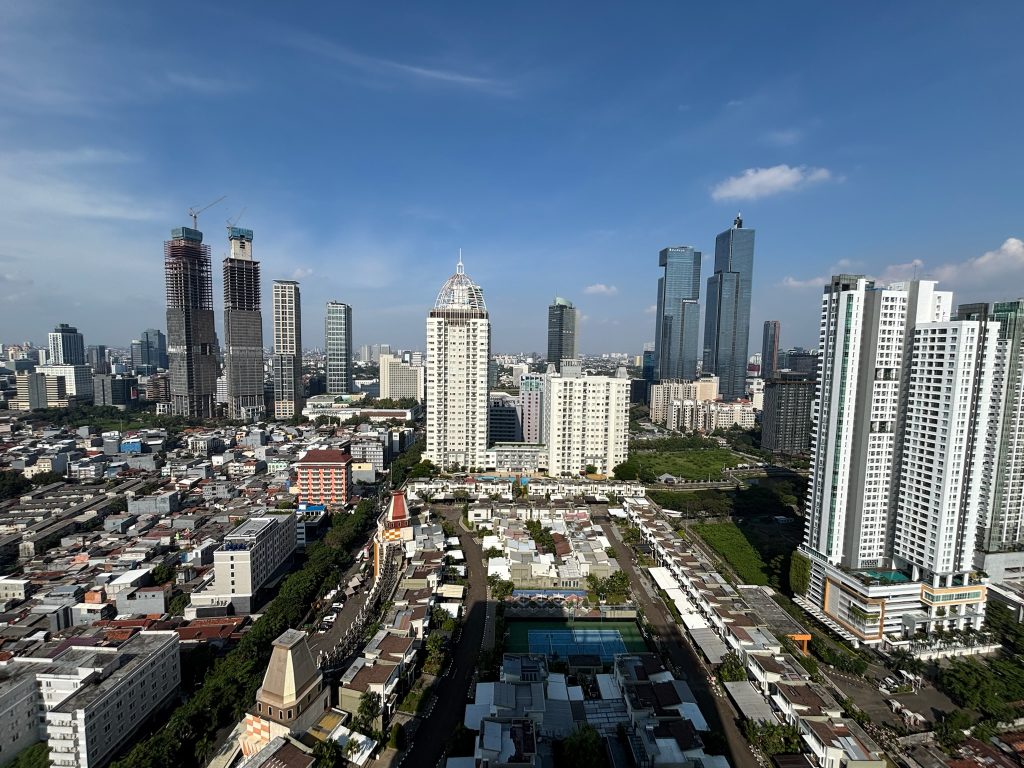
A great example of the difference in height and urban planning designed for the upper classes is Cosmo Park. This luxury townhouse development is located on the roof of the Thamrin City shopping centre, and I discovered it when I looked out of my window that night. There you can see paved streets, a tennis court, swimming pools and residents riding bicycles. This contrasts sharply with the usual cityscape and, as can be seen in the photograph, is located between the contrast of skyscrapers and typical city settlements. This development also reflects the painful climatic and social reality: life at ground level has become impossible, increasingly unhealthy and more exposed to violent flooding, which, added to the fact that the city is sinking, has led to the ambitious project to move the capital from Jakarta to Nusantara.
This was also noticeable on Ancol beach (a public beach!), which is located behind barriers that you can only pass through once you have paid IDR 35,000. On the beach, there is a giant retaining wall that aims to protect the capital from flooding, and on its water and scarce metres of sand, there are hundreds of pieces of single-use plastic and other waste. The promenade was full of people sitting in groups, relaxing and eating. The atmosphere was festive, as it was the day after Independence Day, but the environment was stuffy, dirty, and dark. It was lit only by a crude yellow McDonald’s M and the dozens of people who approached you to offer boat rides or buy food from their stalls.
This beach was a far cry from the typical image one has of a tropical Indonesian beach, and was more in tune with the jungle of dirt and concrete that is the city. It was a shame to see that the water was almost brown, and the children were playing with plastic floating in it, as well as seeing a beach so overshadowed by the dense layer of pollution that it never allowed the sun or stars to be seen.
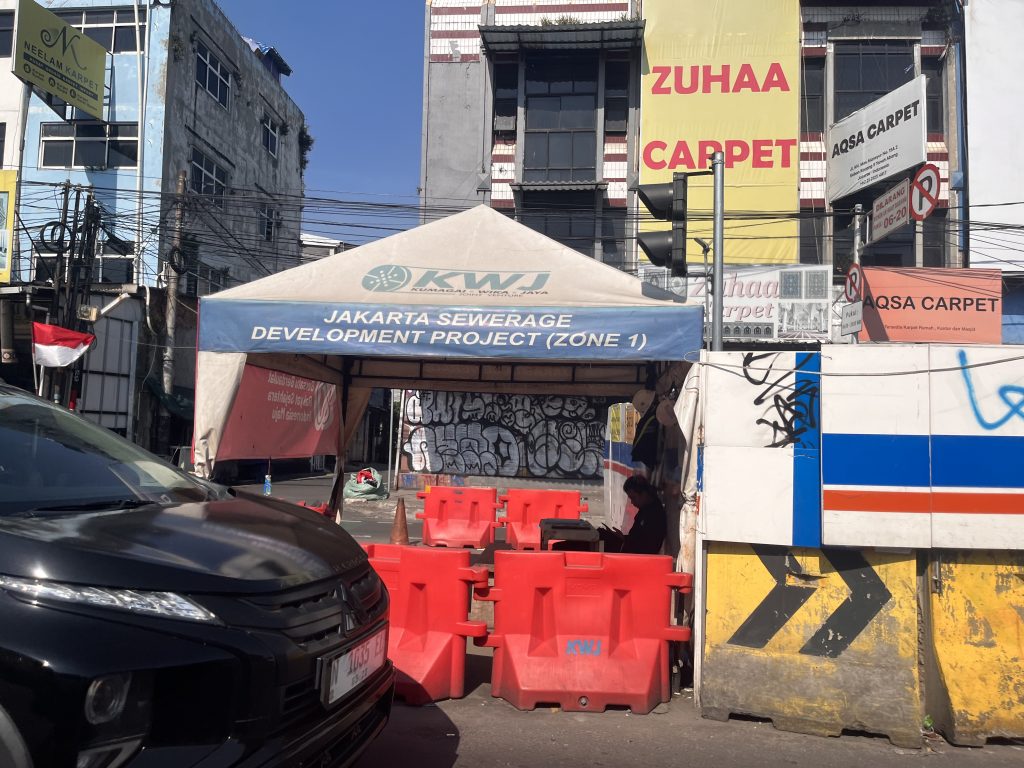
On the road, the chaotic and noisy traffic was only interrupted occasionally by a white tent bearing the words “Developing Project” and blocking the central lanes. These projects could be found everywhere: at the entrance to some settlements, in the middle of roads and on mountain roads (in Bogor). But after the brief seconds when traffic slowed down and relaxed as it passed by these booths, chaos and anarchy returned to the road. Constant overtaking by motorbikes, invasion of oncoming lanes, loud honking horns…anything is possible on the streets. Every time I got into a car, motorbike or rickshaw, I prayed that I wouldn’t be the next to have an accident. At the same time (when I wasn’t in a car), it became an adventure that allowed me to observe the streets, the buildings, and every area I passed through.
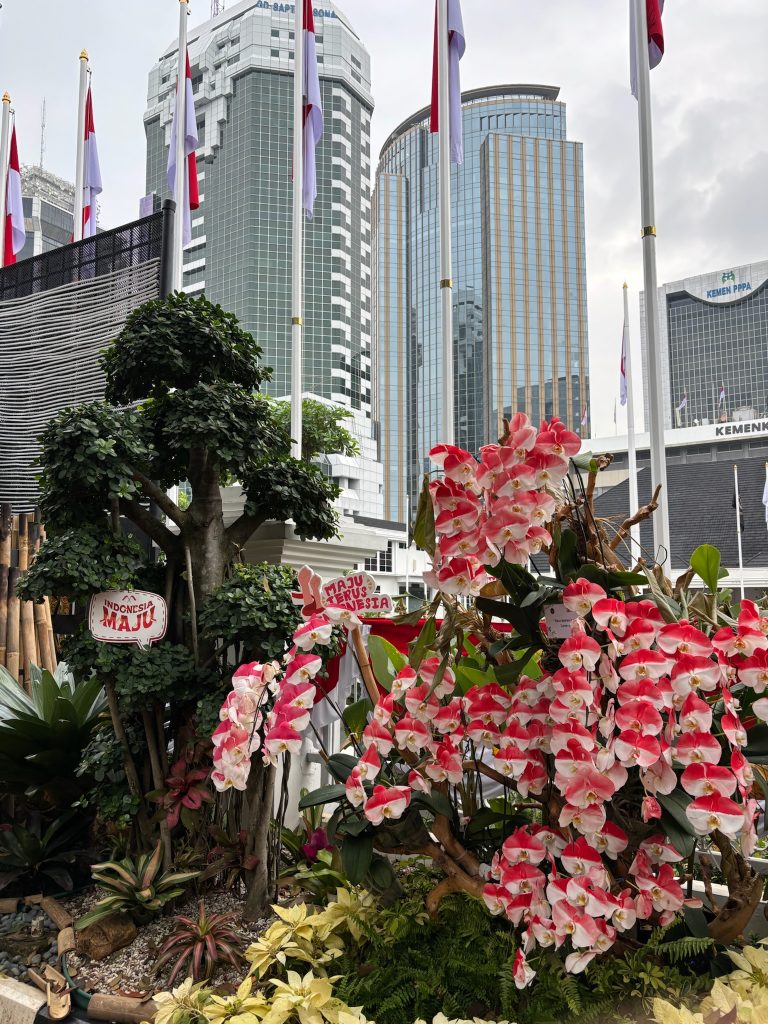
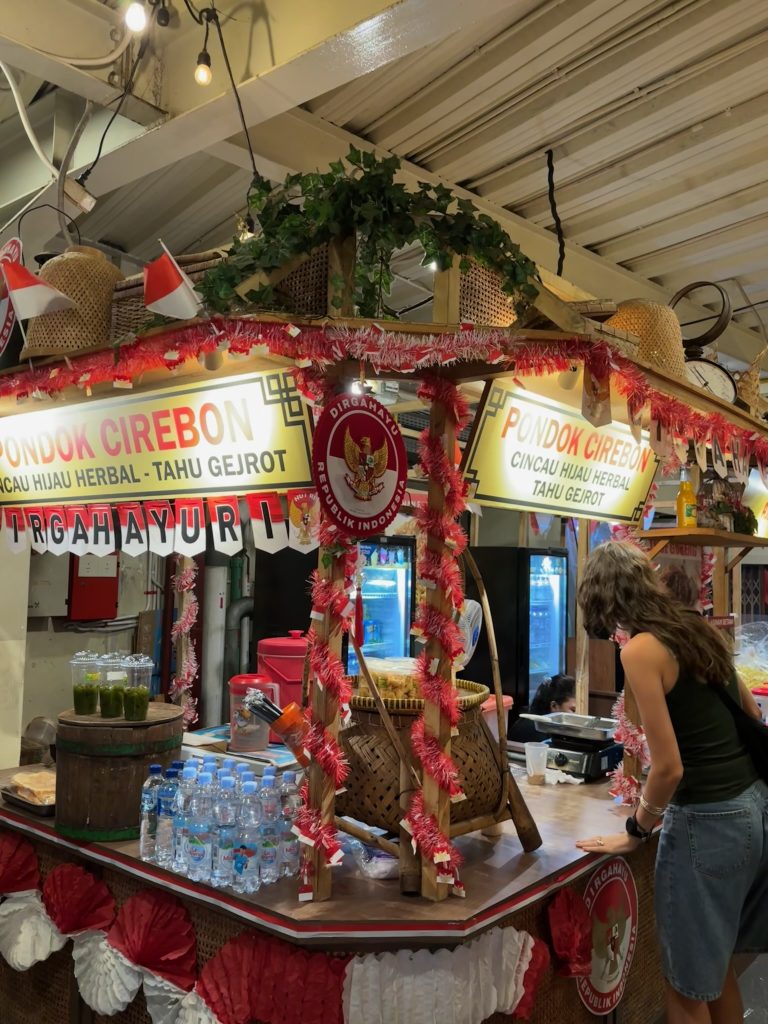
Something that deserves a special mention is the celebration of 80 years of independence. Under the slogan Indonesia Maju (Indonesia forward), the city was decorated with flags and colours a week before (and remained so for at least another week and a half). Everything in the capital revolved around the celebration of independence, even the screens on buildings always showed institutional images and the colours of the flag.
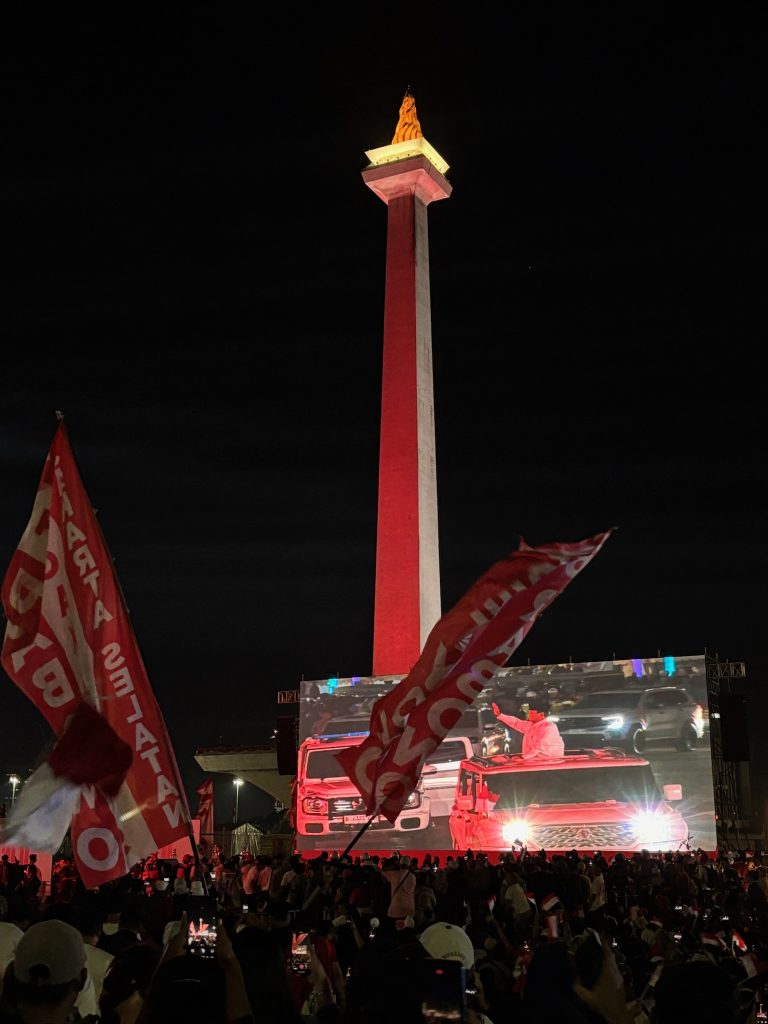
On Sunday, 17 August, the city became almost impassable. A sea of people dressed in red flooded the streets, and the traffic became even heavier, if that was possible. The area around Merdeka Square, where the national monument is located, was turned into makeshift motorcycle parking lots, where men could be seen being paid to watch over them. It was also filled with street vendors selling Indonesian merchandise, food, and drink. Dozens of people walking around with thermos flasks of hot water ready to sell tea and coffee, and stalls selling tofu and fried chicken, welcomed visitors to the square where the celebrations were centred.
A white and red illuminated obelisk and an imposing grandstand in the centre were prepared to welcome the president and witness the start of the parade, highlighting national pride and the country’s progress during eight decades of independence. I was surprised by the lack of cultural representation in the parade, which focused on showcasing different development projects and initiatives, such as digitalization and infrastructure improvements, while it is an immensely diverse country celebrating the end of colonial rule on its territory.
In contrast to this celebration of independence is the old (Dutch) quarter. There, the city changes completely. At the Batavia café (the colonial name for Jakarta), all the diners are European or Japanese, the atmosphere in the square is calm, and businesses raise their prices and change their menus to something a little more European. What struck me most was that the hostels in that area (following the typical European model of youth hostels) advertised themselves as offering the ‘colonial neighbourhood experience’. Suddenly, I had travelled back centuries and found myself in a space made by and for Europeans, with dynamics and aesthetics that made me wonder if colonial rule had really ended.
Indonesia is a very diverse country, both linguistically and religiously, as well as in terms of landscapes and ways of life. Jakarta encapsulates this diversity in all its contrasts and levels, for example, with a small, isolated Buddhist temple within a luxury housing development next to Ancol beach. One of the must-see sights, and a source of pride for many locals, is the mosque and cathedral, built side by side as a sign of tolerance and respect. As we left the mosque, for the first time in my life, a very excited family asked to take a photo with me and my partner. We posed there with all the girls, who were very happy and turned around several times to look at us excitedly. At the time, I didn’t know if it was because we were white with blue eyes, or because we looked like merchandise for the country with the red Indonesian football T-shirts that we had bought on Independence Day.
I enjoyed and learned a lot on the trip, and surely much of my energy came from the very sugary drinks and carbohydrates I ate at every meal with rice and noodles. The experiences in the food courts were the best, eating quickly and cheaply in spaces full of life and, in the case of the one I tried in Chinatown, music and coloured lights.
Although I would not recommend visiting Jakarta for so many days, I am glad that my partner’s sudden bout of flu forced us to take it easy and stay in the city. I was able to discover a great metropolis and reflect on everything I had read about informal settlements, policies of ‘progress and development’ that affect the urban fabric of cities, and understand much better the student protests that began against the government on 26 August, my last day in the city.
A city (and country) that is suffocated by corruption and policies that do not consider the people, but where there are also wonderful people who kindly welcomed us and showed us their reality.
Terima kasih banyak, rakyat Indonesia!