It’s my fourth time in Vienna’s Central Cemetery, but I’m feeling the excitement of the tourist who’s visiting a place for the first time. Back in 2022 —it really feels like ages from now— I came to Vienna for three days, and the cemetery was just another place in a long list of hallmarks which I had written down on my notes app and retrieved from a couple of popular websites that gave recommendations on what to visit in the city. I had planned to go to the Prater park, the Hofburg palace, the gardens of Schönbrunn… and, besides many other places, the Central Cemetery.
All I knew was that many people seemed to consider it a place worth seeing, and some of the all-time famous musicians were buried there: Brahms, Schubert, Beethoven… Of course, my knowledge of the history of classical music is as small as my interest in it, so after taking some photographs of the most iconic graves I went back to the metro station to go and visit the next spot on my list. More than a year later, when I was already living in Vienna, I visited the graveyard again once more just to check that it was still there, out of an impulse to tell my scared self that I was visiting some known land. A couple of weeks after this (again, short) visit, I went with some friends to take pictures of the cemetery now covered in white, because we assumed that, well, all the winter snow would make it look cool.
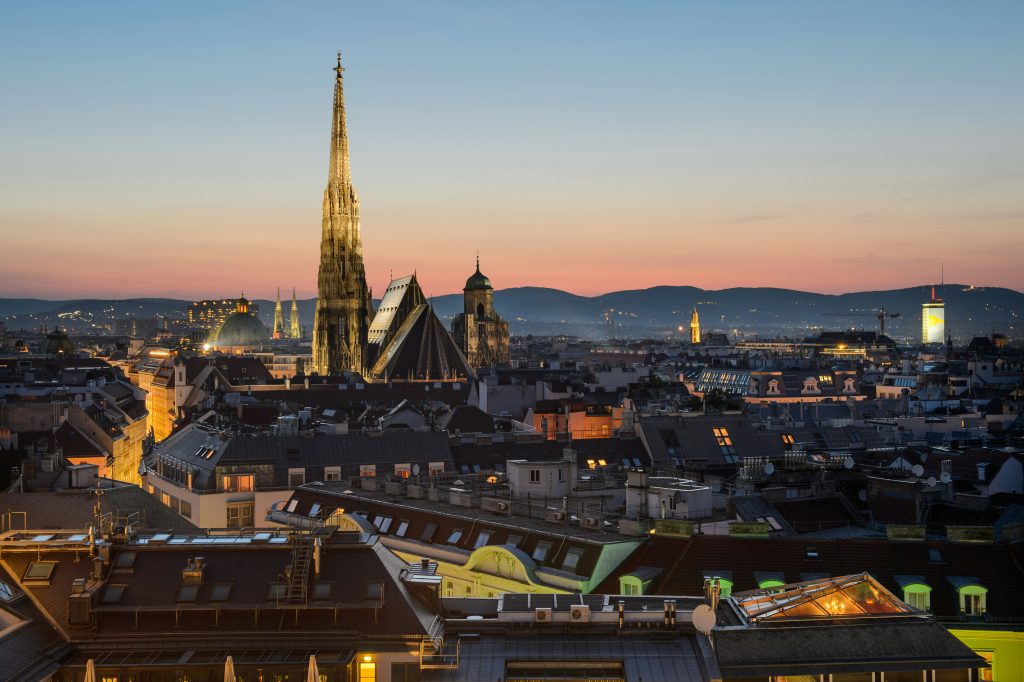
Now, however, after three attempts, I am absolutely convinced that this is the good one, that I really know how to approach it and what to do to pay the cemetery the visit it deserves. Why? Well, now I know some stuff about the history of Vienna, I’ve accessed the Wien Geschichte Wiki as often as —I assume— almost nobody in this city, and I have learned why the place is so significant and why a sixty-minute visit like the ones I made before was definitely not enough for this place.
In her book Somebody Is Walking on Your Grave: My Cemetery Journeys, Mariana Enríquez remarks how we often forget the seemingly obvious fact that, in today’s world, the dead outnumber the living, for which reason it is safe to assume that cemeteries will very frequently be immense locations, and, what’s more disturbing, they will only get bigger, as fertility falls worldwide and populations first start ageing and then declining. Necropolis. That’s the word. That’s the exact term that represents the reality of these locations, actually big cities that we tend to separate from the places where the living dwell, but which too often end up becoming unfathomable and chaotic masses.
In the case of Vienna Central Cemetery, the evidence is particularly shocking. The city reached the two million inhabitants mark at the beginning of the twentieth century and peaked just before the outbreak of World War I, after nine decades of what almost looked like an exponential graph. Therefore, the 1860s city authorities assumed that it would not take more than a century until Vienna became a 4-million-inhabitant metropolis.
Therefore, they planned accordingly and decided to build one of the biggest graveyards in Europe, and to do so on the city outskirts, contrary to what the name of “Central Cemetery” might suggest. Most sources I encounter say that around 3 million people are buried just in this graveyard, which means, if it’s not obvious by now, that there are more dead people inhabiting this cemetery than living in the whole city.
Now I’m aware of all of this, as I’m aware of the influence that the graveyard has had over the lives of Viennese people and its contribution to shaping the identity of the city. Until not so long ago —I read in the book Wienerisch by Lisa Krammer—, “den 71er nehmen” [to take the 71] would be a common slang expression to say that someone had kicked the bucket. The reason behind it is that the tram line 71 was and still is the one that takes passengers to the cemetery, so it was common to say that someone had taken this tram to mean that they had died; during the two world wars, the tram was apparently used to transport corpses to the cemetery.
This time, and unlike the last occasions, I decide to go to Simmering, where the cemetery is located, using the tram instead of the metro. I get into the tram at Schottentor, near the university in the central first district of Vienna, and it will be more than forty minutes until I reach the intended stop.
The first thing that strikes me when I hop off the tram and get into the cemetery, and which I had not paid attention to in any of my previous visits, is the existence of the so called “Friedhofsshop”, that is, an official store that sells (usually humorous) items about the graveyard and the city of Vienna. As far as I remember, this is the first time I see official merch being sold in a cemetery, and it’s even hard to imagine something like that in Madrid’s La Almudena or any other graveyard in Spain. However, the shop is closed and I have therefore no chance to even consider buying any souvenir to reminisce on my visit to Wiener Zentralfriedhof.
Nonetheless, and to compensate for this, I see people entering a café that’s just next to the entrance of the cemetery, and I decide to pay the money I didn’t spend in the souvenir shop to get an overpriced piece of Sacher cake. I reckon this is also the first time I encounter a cafeteria inside a cemetery, but it’s actually quite strange not to see almost any visitor near the spots which seem to be meant to make everything as touristy as possible. The horse-drawn carriages, so popular in Vienna and in this necropolis in particular, are all parked and empty, but the bored coachmen don’t look especially impatient or eager to get clients.
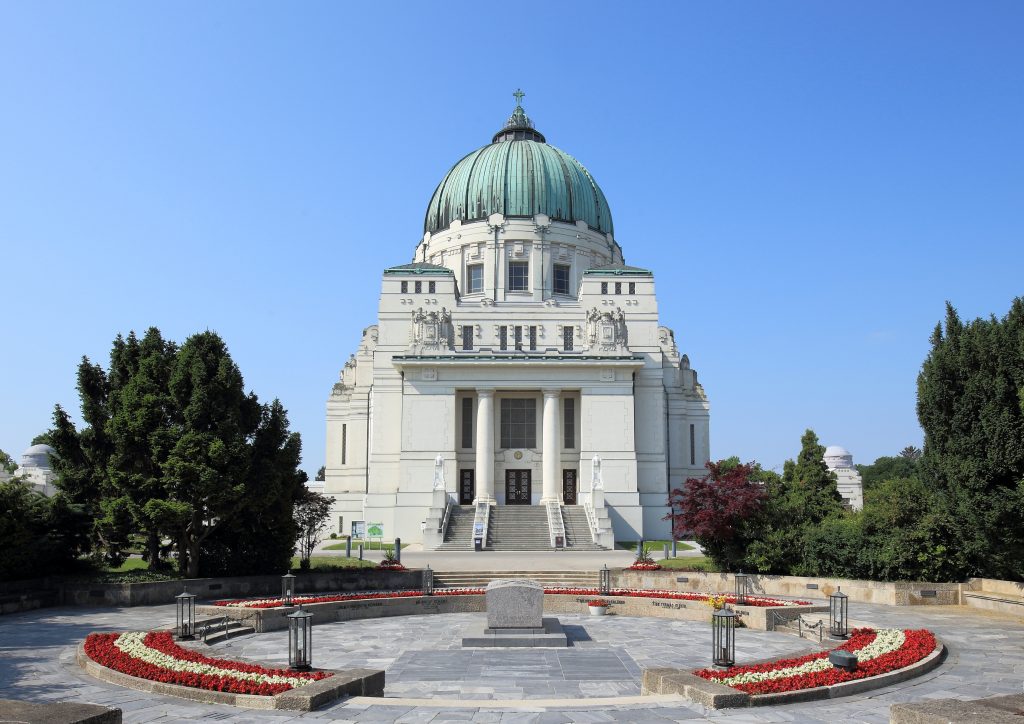
As so happens with many spots in this city, the cemetery is a byproduct of Vienna’s grandeur during the second half of the nineteenth century. The Friedhofskirche zum heiligen Karl Borromäus —the Jugendstil church that surmounts the cemetery— reminds me of the well-known baroque Karlskirche in central Vienna, but its interior is much more humble, being that of a city that was already, albeit slowly, heading towards democracy.
Until some years ago, it was also called Dr.-Karl-Lueger-Gedächtniskirche, honoring the figure of what’s probably the most famous mayor Vienna has ever had, as well as the most controversial one. The Christian Social politician, who is buried in this church, was regarded during most of the 20th century as the man who turned Vienna into the modern capital of a great European power, but perhaps one of the most memorable images tourists get from Vienna is that of his defaced monument with spray painting recalling the mayor’s antisemitism.
Those contradictions, which to a large extent shape every attentive walk through the capital of the old Habsburg Empire, exacerbate when one penetrates in the cemetery. Leaving the church behind, I start feeling that the tourist attraction is over and I can properly wander through the necropolis.
A major contradiction, a historical anomaly, comes from witnessing the treatment that the deceased from the two sides of World War II receive. Just behind the Friedhofskirche stands the Soviet War Memorial; a statue of a defying Soviet soldier, a sober monument in German and Russian reminiscing the war efforts to liberate Vienna of nazism and the graves of the more than 2,600 soldiers from the Red Army fallen in the fight for Vienna have been assigned a privileged location, probably forever, in one of the most visited and iconic cemeteries of the world.
Where can I find the losers of World War Two? That is the most obvious and intriguing question that I ask myself just after my surprise when seeing the graves of foreign soldiers in such a prominent place in the graveyard. After all, I assume that many of the soldiers that lost their lives against the Soviets would have been from Vienna, their parents could be buried here and maybe also their sons and daughters. I walk amid many tombs, most of them absolutely neglected, belonging to people long forgotten with no living relatives in this region. I know this cemetery is a big city in its own right, so I don’t mind spending time strolling through its irregular ways, imagining myself as a sort of flâneur of the necropolis.
At the very edge of the cemetery, already approaching the rail tracks that surround it, an enormous field full of grey crosses, all of them looking the same, with no flowers or other relic near the graves, reminds the only visitor (me) that more than 7,500 people, most of them from Vienna and nearby regions, were sent to a cruel death in the name of the Nazi regime and its ideals. Moreover, those people were forgotten, buried in extremely humble graves, confined to the very end of the cemetery as part of an uncomfortable legacy that had to be left behind.
The immensity of this section adds to the discomforting feeling that I’m lost, I’ve got no battery on my cell phone and I can only see tombs around me. The annoying noise of the planes and their enormous presence just some meters above my head have to do with the proximity of the Schwechat airport, which somehow ruins any expectation of silence and rest in the cemetery. At the same time, it seems as if the planes were actually flying towards the cemetery, as if in a dystopian world where graveyards have taken over cities, with the few survivors left on Earth travelling to the cemeteries of the world trying to reconstruct what the different human cultures look like.
As I walk around with no purpose or direction, I realize I’ve been here for more than three hours, and to this point it has definitely been a worthwhile visit, but there’s still too much left to explore.