Less than ten years ago, San Salvador was known as the homicide capital of the world. With a rate of 103 murders per 100,000 inhabitants in 2015, the country was one of the most insecure in the world, hostage to gang wars and a public sector incapable of dealing with crime. Eight years later, in 2023, that rate has dropped to 2.4 per 100,000 inhabitants, making El Salvador one of the safest countries in Central America.
This radical change in El Salvador’s situation has a name and a surname: Nayib Bukele. Since taking power in 2019, the Salvadoran initiated a series of massive controversial reforms in the country with the goal of ending insecurity. As of today, he is known as a “savior” by some and a “tyrant” by others. How has Bukele managed to end the deplorable situation in the country? What controversies is he starring in to be known as the “best dictator in the world”?
El Salvador belonged to the Captaincy General of Guatemala within the Viceroyalty of New Spain until its independence in 1821. After that year, El Salvador became part of the United Provinces of Central America (later the Federal Republic of Central America), which eventually dissolved 38 years later, the small Latin American country being the last to gain independence from the federation.
Without many natural resources and without a consolidated administrative structure of its own, El Salvador as an independent state had a somewhat difficult beginning. The economy at that time was based on agriculture and livestock, in fact, the period between 1876 and 1931 is known as the “Coffee Republic” since coffee became the basis of the country’s economy.
The fall of coffee prices in the 1930’s led the country to a period of crisis dominated by military governments that laid the foundation for a militarism that would lead, among other reasons, to the Civil War of 1980-1992. This war devastated the country in every way: more than 70,000 dead, institutions “disappeared” and a state that was no longer able to provide basic services such as health, education and (what would be decisive for the increase in crime) police.
While the United States supported the Salvadoran regime against revolutionary forces (communists and others), the legal and institutional vacuum favored the creation of criminal gangs. The pre-Bukele governments tried to implement different plans to try to reduce criminality without success. Due to the insecurity and the economic situation of the country, many decided to migrate; there are currently two million Salvadorans abroad, which is equivalent to one third of El Salvador’s population of six million today.
The year 2015 ended with a homicide rate above 100 per 100,000 inhabitants and El Salvador was known around the world for being the crime capital of the world. However, after the 2019 elections everything would take a radical turn.
Nayib Bukele was born in 1981, just after the start of the Civil War. His parents were of Palestinian descent, hence his not-so-common name in a Spanish-speaking country. His grandparents migrated from Palestine to El Salvador in the early 20th century and went on to build lucrative businesses in the country. It can be said that Bukele “never went hungry”, and belonged from a young age to the top of El Salvador’s economic pyramid in contrast to the poverty of the rest of the country.
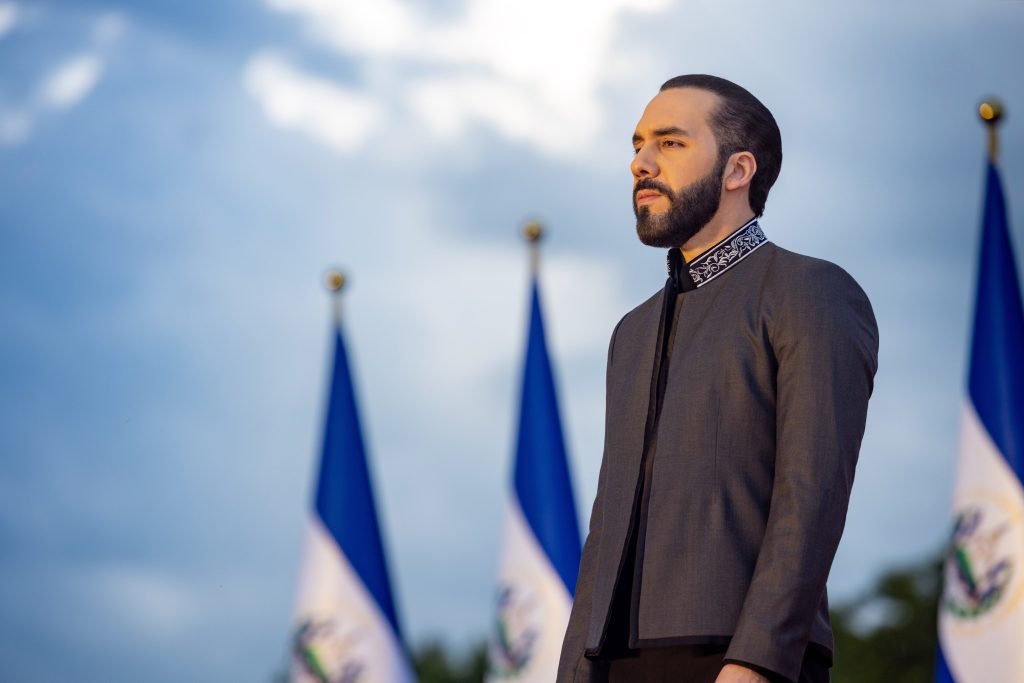
Nayib left law school in his early years to work in one of his father’s companies. Gradually he worked his way up through different positions in these companies until he became president director of 4am Saatchi & Saatchi, a company focused on advertising. Given the nature of these companies, Bukele maintained close relations with the FMLN, one of the main political parties in El Salvador, for which he produced its political propaganda.
Bukele ended up joining this party, with which he managed to win the municipal elections in Nuevo Cuscatlán, a small municipality on the outskirts of the capital. Even then he was known as an arrogant and ambitious character. His mastery of social networks to mobilize his voters allowed him to grow in popularity and win the municipal elections in San Salvador. After some disagreements with members of his party and different corruption scandals, Bukele decided to found his own party in 2017 called Nuevas Ideas.
Failing to register in time with his own party for the 2019 presidential elections, Nayib Bukele decided to join another valid party (GANA) and thus formalize his candidacy. On February 3, 2019, the young Bukele won the elections with 53% of the vote ending the three decades of leadership of the FMLN, the party to which he belonged in the past.
In addition to making Bitcoin one of the country’s official currencies and other curious reforms, Bukele’s priority was to end the crime that had been terrorizing Salvadorans for decades. The solution? An iron fiest as never seen before.
In 2022, Bukele used a spike in homicides to declare a “State of Emergency,” suspending various constitutional rights including the right to know why an arrest was made. In that year alone there were 80,000 arrests, equivalent to 2% of the population. Organizations such as Human Rights Watch were quick to report abuses of power by the police and military due to the partial suspension of some parts of the constitution.
Human Rights Watch also reported that some police had “quotas” for which they were required to arrest a certain number of people per day. Bukele has publicly defended these policies and has even argued that the measures should be harsher for “criminals”. Some detainee hearings were held en masse, with up to more than 500 participating in a single hearing.
Also in 2022, Bukele led a series of reforms to the penal code aimed at increasing prison sentences for gang members (which he himself labels terrorists) and lowered the minimum age to be tried for gang membership to 12 years. Another reform that same year extended the crime of “illicit groupings” (gangs) to those who collaborate, promote, facilitate or favor these groups, making it easy to arrest almost anyone for gang membership (including critical journalists).
Despite having constructed an anti-corruption rhetoric to improve El Salvador’s economy based on a free market model, Bukele has reduced the transparency of many government agencies involved in the provision of public information. Such information was used by journalists to analyze the authoritarian drift of the Bukele government, which, according to some, has turned the country into a “police state”.
The Bukele government has not only invested in the capacity of law enforcement to carry out mass arrests, but also in the construction of places to lock up convicts. In 2022, construction began on the “Centro de Confinamiento del Terrorismo” (CECOT), a massive prison that occupies 116 hectares and has the capacity to lock up more than 40,000 prisoners.
The project was completed in just 7 months and soon its images began to travel around the world. Overcrowded cells, prisoners sleeping piled one on top of the other, lights that never go out, suffocating heat…etc. A real hell in the middle of the Salvadoran countryside.
The more arrests the police and Bukele’s government made, the more crime dropped and the more popular the Salvadoran president became. In the 2024 elections, Bukele won with a landslide 88.3%, making a runoff election unnecessary. Some details of the election rules were changed months before the elections under Bukele’s initiative. The electoral observation mission of the Organization of American States concluded that “the modifications in the electoral law go against universal standards on the independence of judicial and electoral bodies.
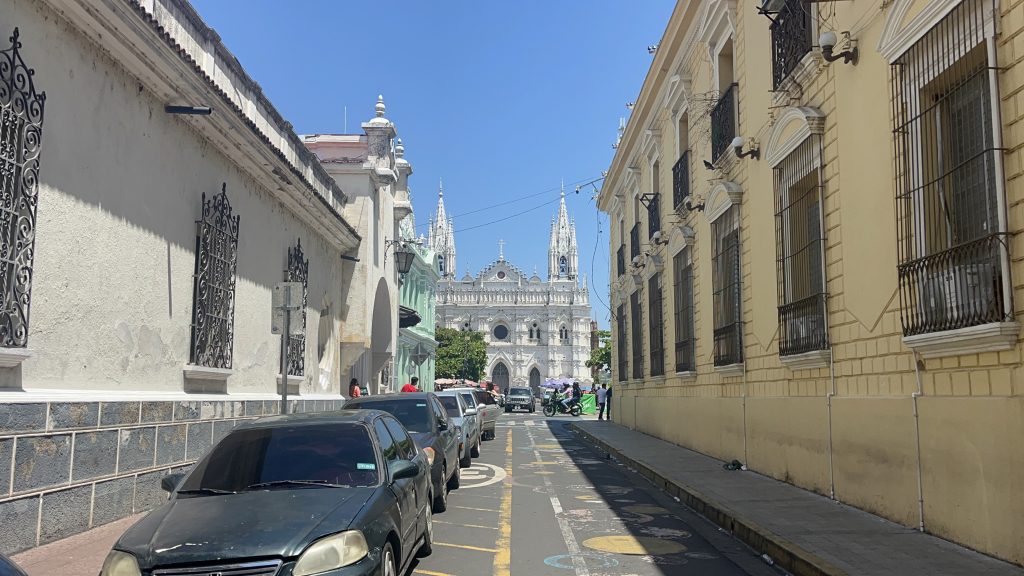
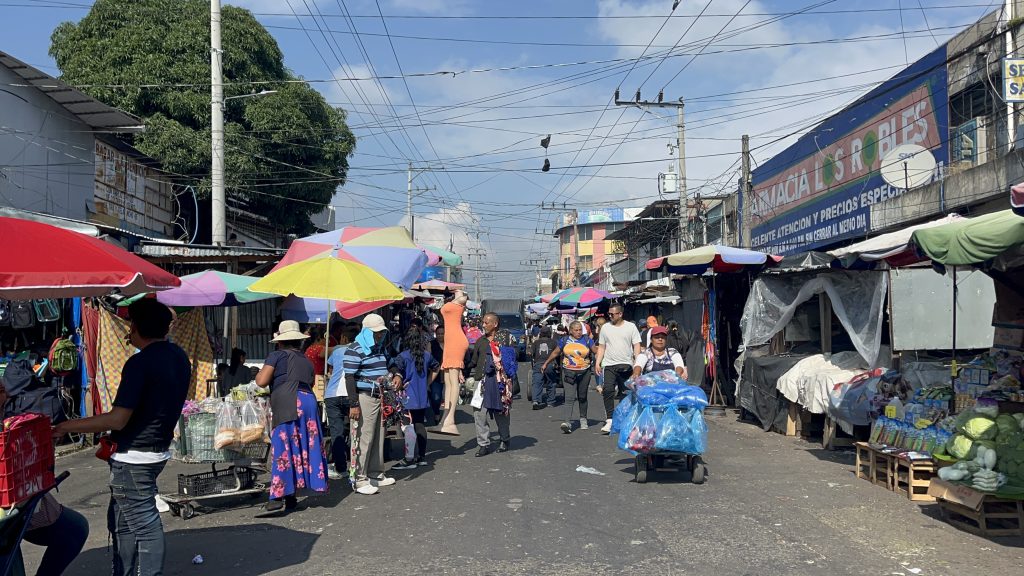
Walking around San Salvador, Santa Ana and other Salvadoran towns feels safer than in many Spanish cities. Leaving some curious glances behind, it seems as if El Salvador has never been the most dangerous country in the world. People throng the streets at all hours of the day, even on weekends and holidays. The most central areas of the cities are overflowing with Salvadorans who enjoy the cultural offerings, the public squares, the many street food stalls and, above all, the security that did not exist ten years ago.
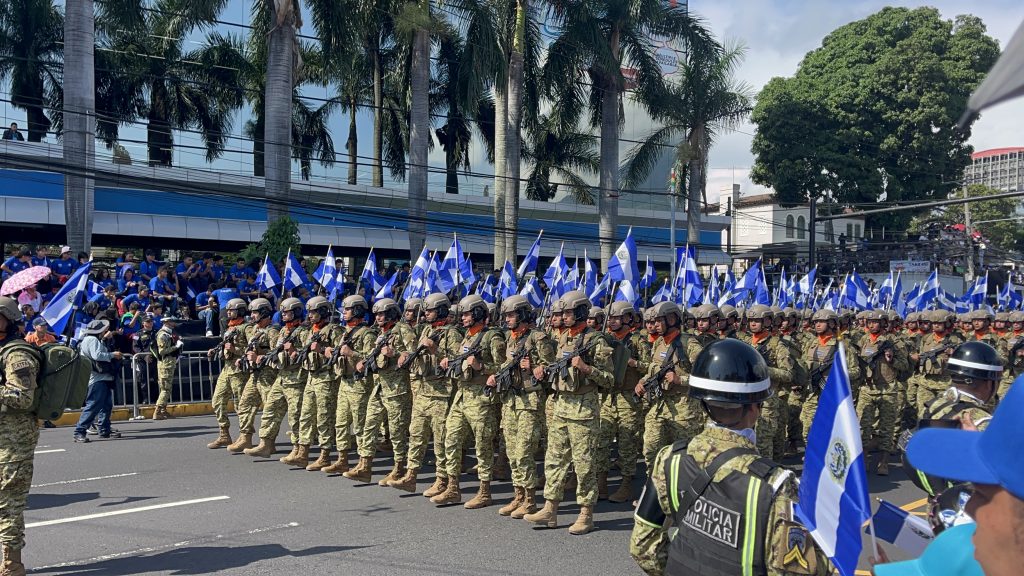
Order in the streets is maintained with an intimidating police (and military) presence on every corner of the city. Well armed and attentive to the crowd, these units try to keep El Salvador as the “safest country in the western hemisphere”, Bukele’s (erroneous) claim.
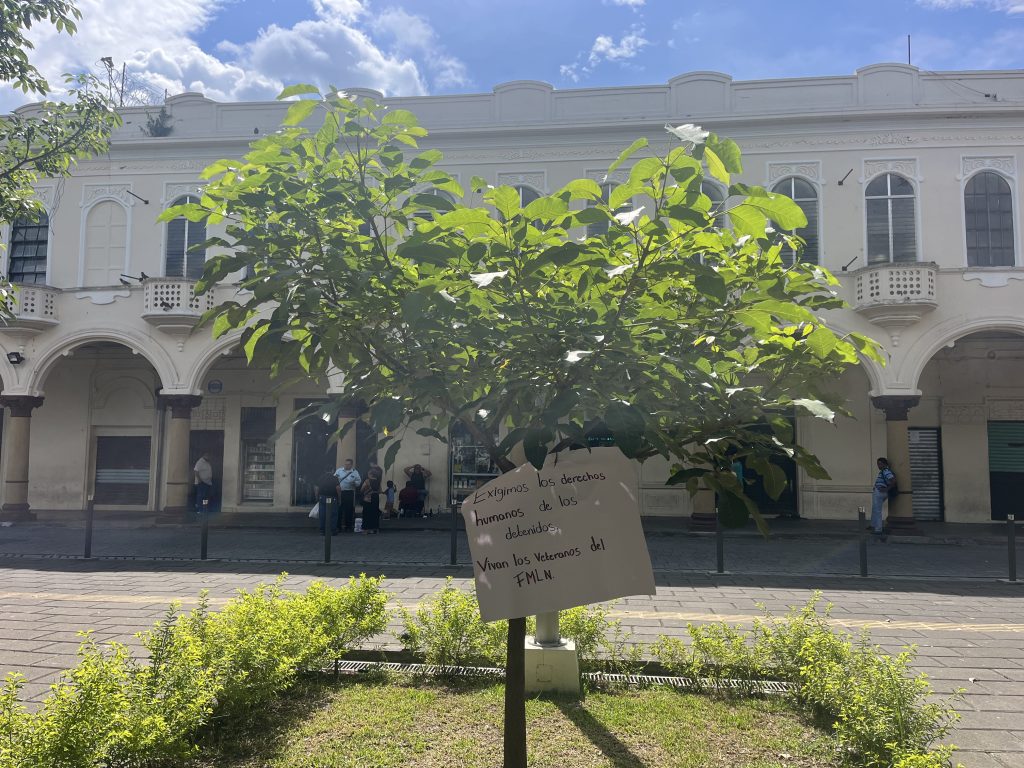
A cab driver comments that “all Salvadorans have a history of death. He assures that before he could not do his job peacefully, but now everything is different. In this report it was not possible to find a single person critical of Bukele and, especially, his handling of crime. As an exception, in Plaza Libertad one can read a timid sign that says: “we demand the human rights of the detainees”, “long live the human rights of the FMLN” (the FMLN is the opposition to Bukele, the former ruling party).
Bukele’s control has traces of some of the policies employed in absolutely authoritarian countries. Not only do the police arbitrarily detain people suspected of being part of a gang, but there have also been reported cases of torture, publicly supported by Nayib. The New York Times speaks of spy programs to monitor some journalists. Similar to Trump, Bukele has labeled many independent media that criticize him as “fake news”.
NACLA reports that the media outlet “El Faro” was attacked by the famous Pegasus spyware by Nayib’s government. The Salvadoran president’s argument is that “the press supports criminal gangs” with its criticism of Bukele. The leader of El Salvador tries to label as criminal anyone who contradicts him in order to get rid of the opposition.
In 2021, the New Ideas party replaced Supreme Court magistrates with party affiliates in order to take over the judiciary, which has allowed the young president to circumvent some of the “constitutional restrictions” on his authority, such as the limitation on running for president again.
What is certain is that the “Bukele model” has influenced other Latin American nations in dealing with crime. Both Honduras and (more recently) Ecuador have implemented a similar policy, albeit with worse results. Bukele seems to have found the key to controlling crime, but has taken several steps backwards in democratic values and human rights.
In New York, I had the chance to speak to an anonymous Salvadoran who has been living in the United States since he was a child. The interviewee expressed his fear of returning to the country since his body is covered with tattoos. Faced with uncertainty, he prefers not to return. Another anonymous “wealthier” Salvadoran confesses her concern for the state of Salvadoran democracy and shows her slight rejection of Bukele, however, she admits that the former critical security situation in the country did not affect her as much since she had a personal escort and guards at her home. In general, the opinion of Salvadorans abroad is more negative than that of those residing in El Salvador, but perhaps it also has to do with the economic capacity of the migrants.
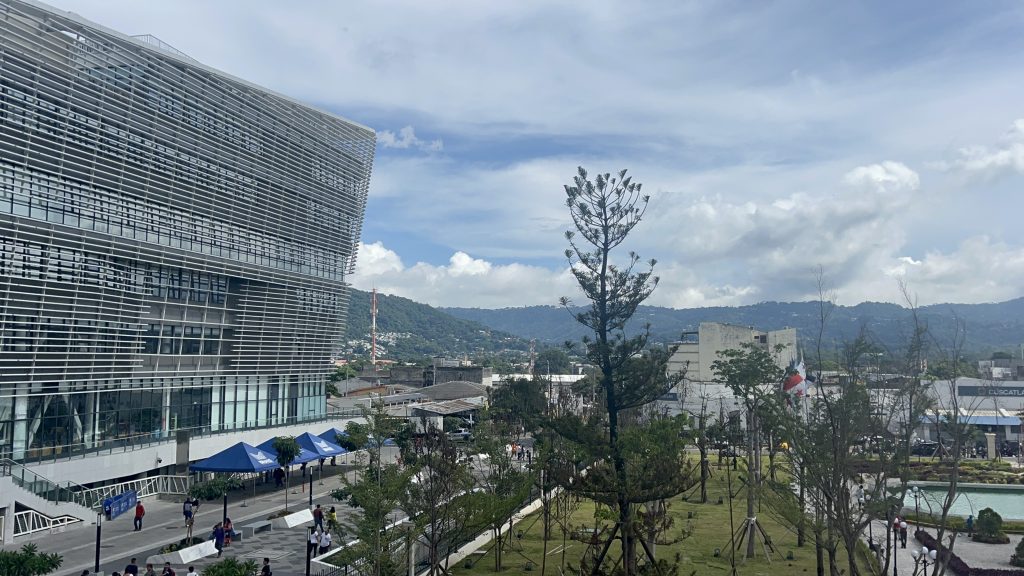
In the center of the capital stands the imposing BINAES, or “National Library of El Salvador”. At its entrance proudly displays the Salvadoran flag…and the Chinese flag. El Salvador is part of Beijing’s “international development support” route, with its well-known megalomaniac projects. The library, although imposing on the outside, is somewhat limited in terms of the contents inside. Signs in Chinese can also be seen inside.
The Salvadoran president has tried to combine a rapprochement with China with a pro-Western and pro-US rhetoric. In a few years, locals say, a new stadium with a capacity of up to 50,000 spectators, also financed by Beijing, will be completed. For the moment, Bukele has done well: he has recently announced that on September 30 the first budget in decades will be presented to the Legislative Assembly without the need to issue a single cent of debt: El Salvador will be “fiscally independent”.
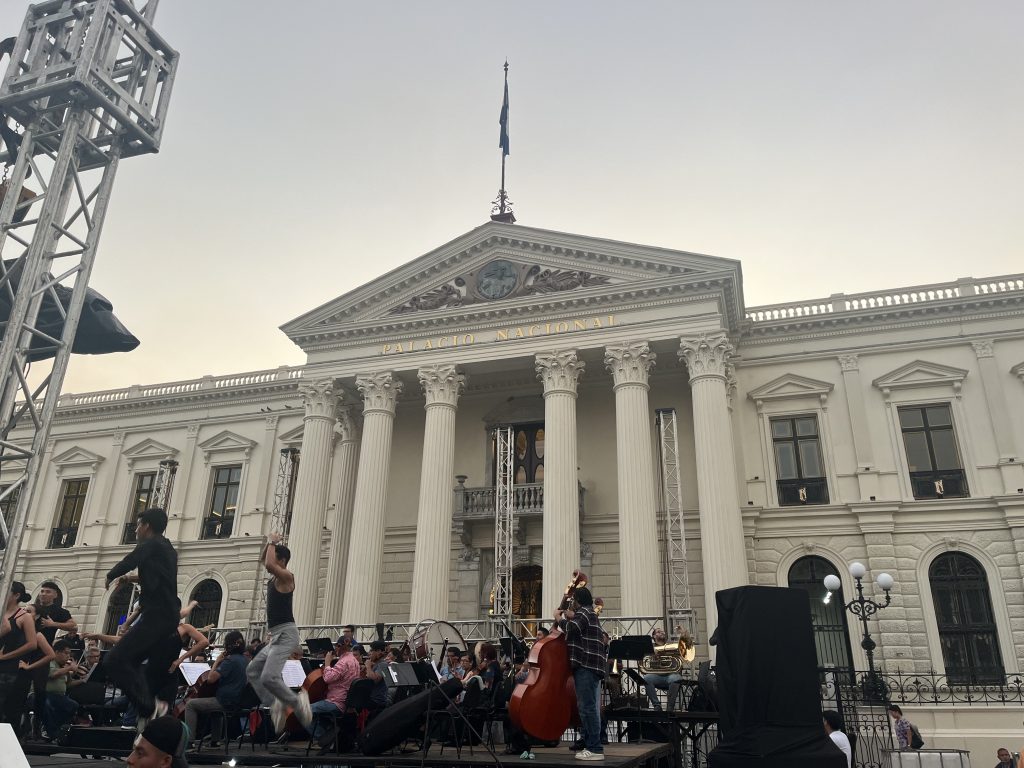
This announcement was made on the country’s national holiday, which coincided with my trip to El Salvador. The independence of several Central American countries from the Spanish Empire is commemorated every September 15, and parades are held in the country’s largest cities.
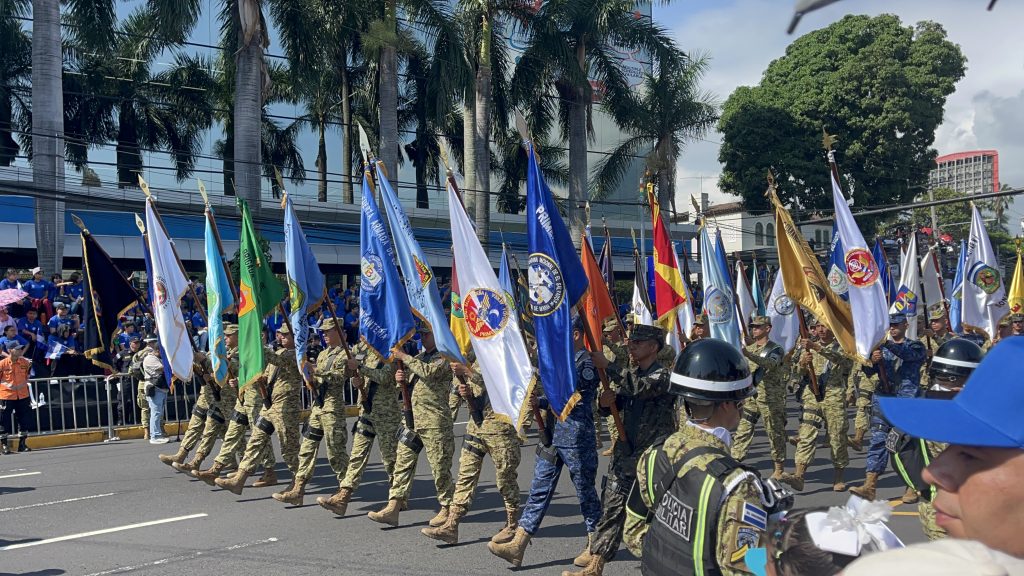
Since Bukele’s arrival, such parades have become more and more impressive, with broad civil society participation. Loudspeakers on each side of the avenue along which the different units march repeat a propagandistic speech during each part of the parade praising Bukele’s work in improving whatever is on display.
During intervals in the parade, the loudspeakers repeat phrases such as, “thanks to the work of our president Nayib Bukele and the first lady, now our young people can enjoy a future of opportunities.” The propaganda speakers also allude to the “New Salvador” since the young president came to power and the improvement of security in the streets. Something that is striking in the parade is the extensive presence of the police, whose parade ended up being longer than that of the armed forces.
El Salvador today (and even more so during its national day) shows clear signs of a country that is slowly building a prosperous future, with improvements in key sectors such as security, education and infrastructure. In addition, Bukele’s economic policy is attracting numerous investments to the small Central American nation from which the local population benefits and which are gradually increasing the wealth of what was once one of the poorest states on the entire continent.
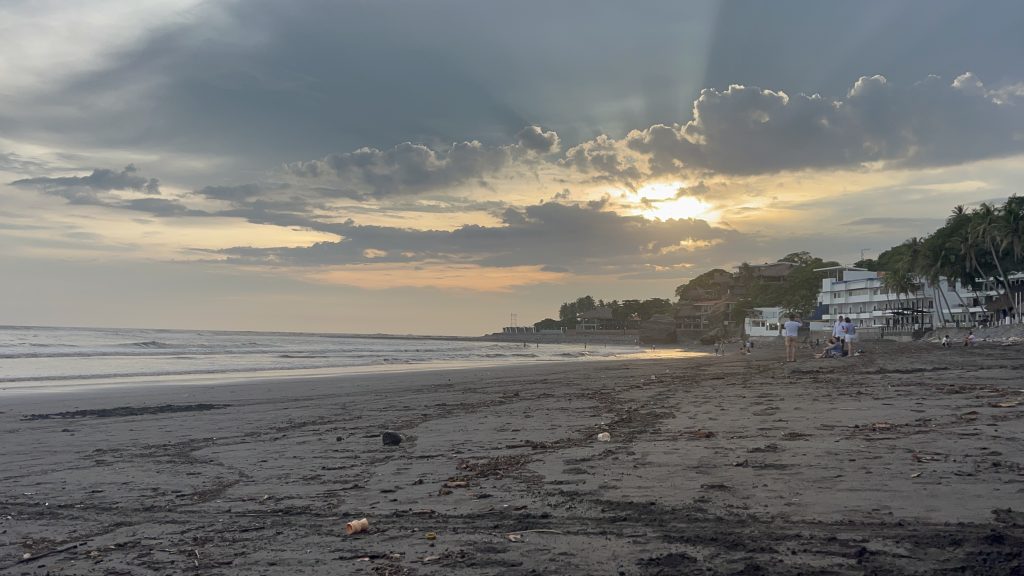
An example of this is the “Surf City”, an investment framework on the coast of the country to develop the tourism sector around its potential for surfing. As of today, this project is at an early stage and many of the beaches still lack decent infrastructure and the healthiness of the place leaves much to be desired. Even so, the project continues to move forward and is reflected in the numerous works visible along the coast.
The country is breaking with a cursed past and entering an era of economic bonanza and security for Salvadorans. However, this does not mean that El Salvador today does not have traits of becoming a personalist regime and (almost) cult to the figure of Nayib Bukele. Taking into account what was seen during the national day and listening to the opinion of Salvadorans, the President of the Republic is treated as a deity, which leads many to justify his anti-democratic reforms, which could have consequences in the future when the Bukele model begins to fail.
The figure of Nayib Bukele is undoubtedly controversial. One cannot attempt to judge the President without taking into account all that he has managed to change (for the better) in El Salvador as well as his anti-democratic reforms and policies that undermine human rights. While the international community asks the question: hero or tyrant? El Salvador moves forward and Bukele embarks on his second term, which for now does not look like it will be the last one.